


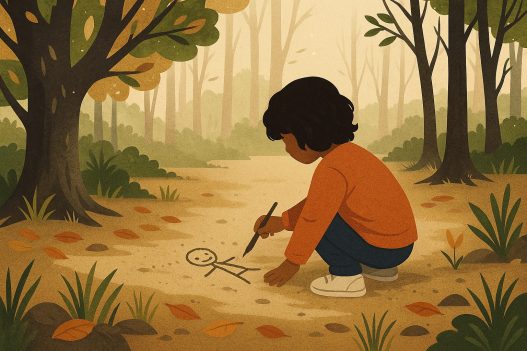
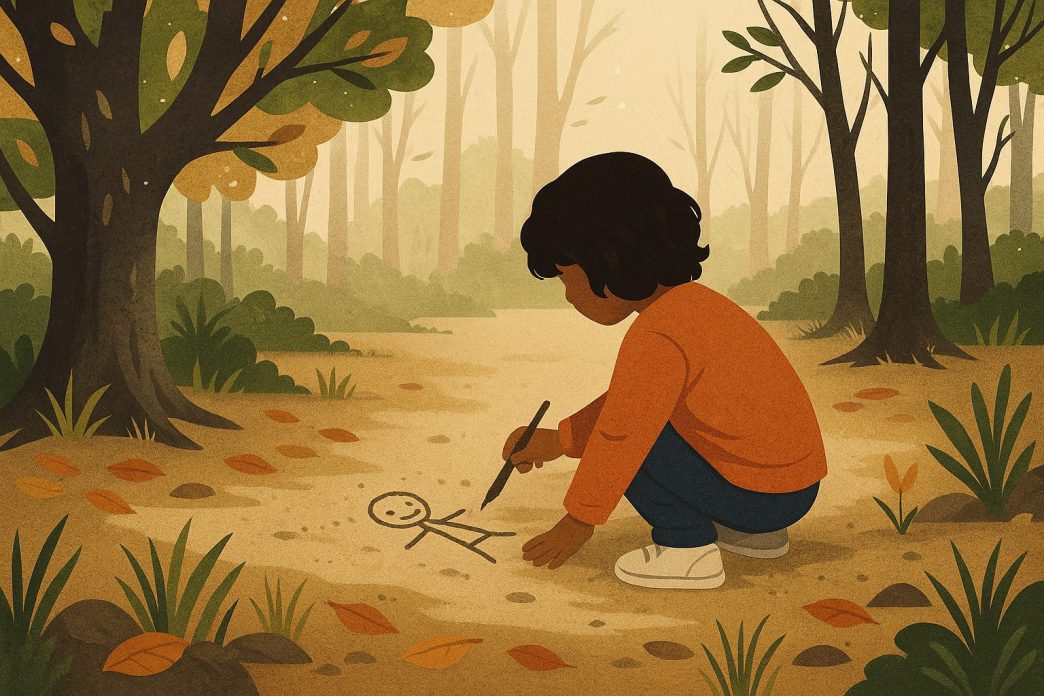
There’s a certain kind of silence that only happens outside. The kind where you can hear the wind tapping through the trees, a blackbird singing somewhere close, and the unmistakable sound of a stick scratching lines into dry soil.
To an adult, it might look like your child is just poking about. But to them? It’s a story, a map, a dinosaur, a rocket. And according to child development experts, that quiet time spent drawing in the mud could be doing more for their brain than a worksheet ever could.
It starts with the stick
Give a child a stick and they’ll find something to do with it. Drawing in the mud is one of the oldest, most instinctive ways children create. No prep, no glue, no tidy-up time — just a connection between hand, mind, and the natural world.
When a child draws shapes, lines or figures on the ground, they’re not just being “arty.” They’re building motor planning, spatial awareness, storytelling, and even early literacy skills — all while their feet are planted firmly in the earth.
Messy = meaningful
There’s been a growing push in recent years to let children get messy — not just in the art sense, but physically out in nature. From mud kitchens to forest schools, the benefits are well documented.
But it doesn’t have to be a planned activity. In fact, some of the best developmental moments happen when children are left to explore freely with minimal adult instruction.
Drawing in the mud allows for:
- Sensory feedback – feeling the resistance of soil, pressure of stick
- Fine motor development – using wrists and fingers in controlled ways
- Focus and flow – children often enter a calm, creative “zone”
- Language growth – narrating what they’re drawing builds vocabulary
- Confidence – no “right” or “wrong” outcome, just open-ended play
It’s screen-free and cost-free
At a time when screen time is creeping higher — and everything seems to come with a subscription — it’s oddly reassuring to realise your child can still be totally absorbed by a patch of dirt and a twig.
It’s a reminder that children don’t always need new things. They need time. Space. And permission to follow their curiosity.
Even 15 minutes in the garden or park can be a reset for little brains (and big ones too).
What are they learning?
Early years educators often talk about mark-making — those first lines and scribbles that eventually lead to writing. Drawing in the dirt is part of that process.
Whether it’s shapes, spirals, letters, or little characters with oversized heads, your child is:
- Practising control over their movements
- Beginning to understand symbols
- Engaging in early storytelling
- Learning how to express ideas visually
If they’re working alongside siblings or friends, you’ll also see collaboration, turn-taking, and communication unfold naturally — all without a lesson plan in sight.
How to encourage it
You don’t need a forest school setup. Here’s how to invite dirt-drawing into your everyday:
- Leave a stick or two in the garden or take one on your next walk
- Find a patch of soil, sand or gravel – even a flower bed edge will do
- Avoid interrupting – let them lead the play
- Ask open questions like “What’s happening here?” or “Who lives there?”
- Take a photo before it rains to “keep” their artwork
Just be prepared to wash a bit of mud off hands (and maybe trousers).
???? Mud Drawing Days Out This Autumn (That Won’t Cost a Penny)
Looking for the perfect patch of soil, leaves, and imagination fuel? Here are a few Essex spots where kids can get stuck in — literally. All free to visit, and ideal for a post-school or weekend wander:
• Danbury Common
Twisting woodland trails, hidden clearings, and sticks galore.
• Chignal Forest Walk (Chelmsford)
A quiet, buggy-friendly path with plenty of leafy space to play.
• Hylands Estate (back fields)
Step away from the playground and you’ll find dirt tracks made for stick art.
• Weald Country Park (Brentwood)
Big skies, old trees, and just enough mud to keep things interesting.
• Shoebury Common (Southend)
If the tide’s out, the sand becomes a giant canvas.
???? Tip: After rain? Even better. Just bring a spare pair of socks.
One last thing…
If your child is drawing in the mud, let them. Better still, join them.
Because those simple scribbles might not be hanging on the fridge — but they’re laying down all kinds of important foundations. Not just for writing, but for thinking, imagining, creating. For being present in the world.
And really, what more could we want?